

In this story (14)
- 011. My living room feels empty: how to make it look finished
- 022. How to make your living room look expensive (on a budget)
- 033. Living room looks cluttered? How to make it feel calm
- 044. How to make a small living room look bigger
- 055. How to brighten a dark living room (without painting)
- 066. How to make your living room cozy for winter
- 077. Living room layout mistakes: furniture against the walls
- 088. Rug size for a living room: the mistake almost everyone makes
- 099. How high to hang pictures in a living room
- 1010. Living room color mistakes: when nothing goes together
- 1111. Why a neutral living room looks boring (and how to fix it)
- 1212. Why your living room looks lifeless: add plants
- 13The 10-minute living room checkup
- 14Fix these first if you are on a budget
You bought a sofa you like, a rug, a few pillows, maybe a lamp. Each piece is fine. The room still looks wrong: empty though it's full, a little cheap, cluttered, or smaller than it is. You can tell something is off; you just can't say what.
Most living room decorating mistakes have very little to do with taste or budget. They come from scale, placement and light: a rug a size too small, curtains hung at the window frame, one overhead bulb doing all the work, furniture lined up against the walls. Fix those and the same things suddenly look designed.
Below are the 12 problems people search for most, in the words they use. Each gets a quick answer, the reason it happens and the fix, with measurements. Find yours in the list and jump to it, or walk your room with the whole thing as a checklist.
Find your problem in 10 seconds
Feels empty or unfinished: 1. Looks cheap: 2. Feels cluttered: 3. Looks small: 4. Too dark at night: 5. Cold, not cozy: 6. Furniture layout feels awkward: 7. Rug looks wrong: 8. Walls look bare or art looks off: 9. Nothing goes together: 10. Boring or flat: 11. Looks lifeless: 12.
Starting from a completely empty room? Our step-by-step guide to decorating an empty room walks you through it from day one.
1. My living room feels empty: how to make it look finished
Quick answer: A living room looks empty when it has furniture but no layers. The usual causes are no focal point, bare windows, a rug that is too small and nothing on the walls. Add those four layers, in that order, and the room looks finished even with the same furniture.
Why it happens
- No focal point. The eye has nowhere to land, so the room feels unplanned.
- Bare windows. Blinds alone leave hard edges and a lot of empty wall.
- A floating rug (or no rug), so the furniture looks scattered.
- Empty walls, or one small frame on a big wall.
- Everything at the same height: sofa, coffee table and side tables all sit low, with nothing tall to fill the upper half of the room.
How to fix it
- Pick one focal point, usually the wall behind the sofa or a fireplace, and make it the most finished part of the room.
- Dress the windows with floor-length curtains hung high and wide (see problem 2).
- Size up the rug so the front legs of every seat sit on it (problem 8).
- Fill the upper half of the room: tall art above the sofa, a floor lamp, a tall plant in a corner.
- Add one textile layer: a throw over the sofa arm and two or three pillows.

2. How to make your living room look expensive (on a budget)
Quick answer: Rooms look cheap because of scale and finishes, not price. The biggest culprits are curtains that are too short or hung too low, a small rug, a single harsh ceiling light, matching furniture sets and lots of small decor. Fixing curtains and lighting alone makes most rooms look noticeably more expensive.
Why it happens
- Curtains hung at the window frame and stopping above the floor. This is the most common one.
- One overhead light with a cool white bulb.
- A matching furniture set (sofa, loveseat and chair from one collection), which looks like a showroom.
- Many small accessories instead of a few larger ones.
- Shiny, thin materials: glossy polyester curtains, plastic frames, flat-pack pieces with visible fittings.
How to fix it
- Hang curtains high and wide. Put the rod 4 to 6 inches (10 to 15 cm) above the frame, or close to the ceiling, and extend it 8 to 12 inches (20 to 30 cm) past the frame on each side. Choose panels that touch the floor. This single change makes ceilings look taller and windows bigger.
- Choose natural-looking fabrics: linen or linen-look curtains, cotton, wool-look throws. Texture reads as quality.
- Swap the bulbs to warm 2700K everywhere and add at least two lamps (problem 5).
- Break up matching sets. Keep the sofa, but swap the matching armchair for a different shape or material.
- Edit accessories to fewer, bigger pieces. One large vase reads better than five small ones.
If you change one thing in this section, make it the curtains. Most store panels are 84 inches, too short once the rod goes up near the ceiling; on an 8-foot ceiling you usually need 96. A rod that extends well past the frame matters as much as the fabric.

Ivory Linen Curtains (96 Inch, 2 Panels)
Floor-length linen curtains, long enough to hang high and still touch the floor.
Affiliate link · we may earn a commission

Extra-Long Adjustable Curtain Rod (72-144 in)
A long rod so curtains hang wide of the window and keep the glass clear.
Affiliate link · we may earn a commission
3. Living room looks cluttered? How to make it feel calm
Quick answer: A living room looks cluttered when there are too many small objects, too many furniture pieces for the space, or nowhere to put everyday things. The fix is to give every item a home with closed storage, group decor in odd numbers, and remove one piece of furniture before adding anything new.
Why it happens
- Everyday items with no home: remotes, chargers, blankets, mail, toys.
- Decor spread one item at a time across every surface.
- Too much furniture for the room, or pieces that are too big.
- Open shelving filled edge to edge.
- Lots of different colors and patterns competing for attention.
How to fix it
- Add closed storage near where things land: a lidded basket or storage ottoman by the sofa for throws, remotes and chargers.
- Group decor into clusters of three on a tray, instead of spreading single items around.
- Leave a third of every shelf and surface empty. Empty space is what makes the rest look intentional.
- Do the one-out rule: before buying a new piece, take one out of the room.
- Limit pillows to two or three per seat section.
A folding storage ottoman is the easiest closed storage to add: a footrest, a spare seat and a box for the throws and chargers that end up on the sofa.
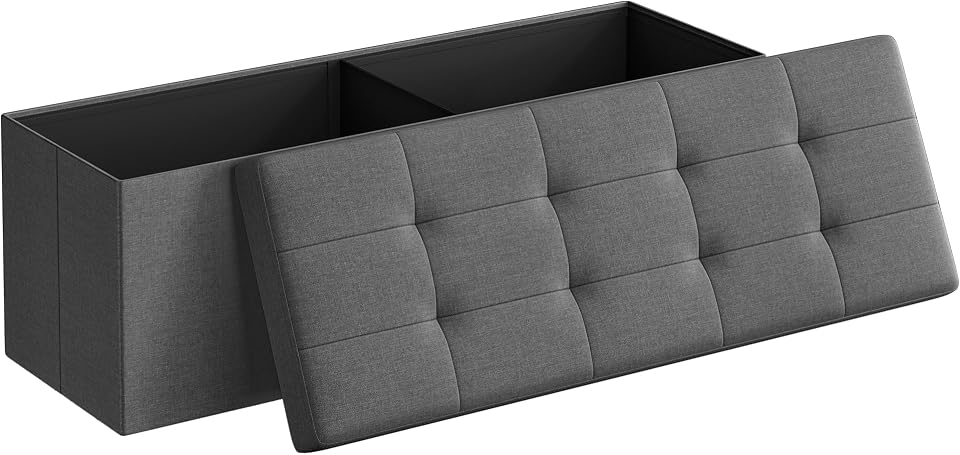
Folding Storage Ottoman Bench
Hidden storage for throws and remotes that doubles as extra seating.
Affiliate link · we may earn a commission
4. How to make a small living room look bigger
Quick answer: A living room looks small when furniture blocks light and floor space, the rug is undersized and the walls stop the eye. Use furniture with visible legs, hang curtains wide and high, add a large mirror opposite or next to a window, and choose one bigger rug instead of a small one.
Why it happens
- Heavy, skirted furniture that sits flat on the floor and hides it.
- A small rug, which cuts the floor into pieces.
- Dark walls with dark furniture and little light.
- Too many small pieces instead of a few well-sized ones.
How to fix it
- Show more floor. Pick pieces with legs (sofas, chairs, consoles) so you see the floor beneath them.
- Add a large mirror next to or opposite a window. It doubles the light and the view. A tall floor mirror leaned against a wall also adds height.
- Use one larger rug. It sounds backwards, but a big rug makes a small room look bigger.
- Keep the palette close: walls, curtains and sofa in similar light tones, with color in the small things.
- Hang curtains to the ceiling. It makes the walls look taller.

Arched Full-Length Floor Mirror
A tall arched mirror that bounces light around a small or dark room.
Affiliate link · we may earn a commission
5. How to brighten a dark living room (without painting)
Quick answer: Most living rooms rely on one ceiling light, which leaves corners dark and makes the room feel flat. Light the room at three heights instead: a floor lamp, a table lamp at seated eye level and a low accent light, all with warm 2700K bulbs, spread out so no corner stays dark.
Why it happens
- A single overhead fixture doing all the work.
- Cool white bulbs (4000K and up), which look harsh in the evening.
- All the lamps on one side of the room.
- Dark shades that block most of the light.
How to fix it
- Use at least three light sources in a living room, at three heights: floor, table and low.
- Place them in a triangle across the room so every corner gets light.
- Use the same color temperature everywhere: 2700K warm white is the standard for living rooms.
- Pick fabric or linen shades that glow rather than hide the bulb.
- Turn off the big light in the evening. Lamps alone are what make a room feel cozy.

Arc Floor Lamp with Drum Shade
An arc lamp that reaches over the sofa with warm reading light.
Affiliate link · we may earn a commission

Warm White 2700K LED Bulbs (24 Pack)
Warm bulbs for every lamp: the cheapest fix for a cold-feeling room.
Affiliate link · we may earn a commission
6. How to make your living room cozy for winter
Quick answer: A room feels cold when it is all hard, smooth surfaces and cool light, and winter makes it obvious. Coziness comes from texture and warmth: a soft rug, a chunky throw, pillows in different textures, wood and warm bulbs. Add three new textures and switch to warm light, and the same room feels completely different.
Why it happens
- Smooth, hard surfaces everywhere: leather, glass, metal, bare floors.
- Only one texture on the sofa and pillows.
- Cool light and cool colors with no warm wood or brass.
- No softness underfoot.
How to fix it
- Layer textures: a knit throw, a bouclé or woven pillow, a wool-look rug, linen curtains.
- Add warm materials: wood, rattan, ceramics, brass.
- Use warm bulbs in every lamp (problem 5).
- Bring in candles or candle-style lights on a tray.

Ivory Chunky Knit Throw
A chunky ivory knit that adds instant softness to the sofa.
Affiliate link · we may earn a commission

Ivory Bouclé Pillow Covers
Nubby bouclé covers that add texture without adding color.
Affiliate link · we may earn a commission
7. Living room layout mistakes: furniture against the walls
Quick answer: An awkward layout usually means furniture pushed against the walls with a big gap in the middle, or seats too far apart to talk. Pull the sofa and chairs into a conversation group around a rug and coffee table, keep 30 to 36 inches for walkways, and use a console table behind a floating sofa.
Why it happens
- Every piece against a wall, leaving an empty middle.
- Seats more than about 10 feet (3 m) apart, too far for conversation.
- The sofa facing a doorway's walking path or blocking it.
- The TV deciding the whole layout.
How to fix it
- Create a conversation area: sofa and chairs facing each other around the coffee table.
- Float the sofa away from the wall if the room allows, and put a console table behind it for a lamp and a few books.
- Keep walkways 30 to 36 inches (76 to 91 cm) wide, and the coffee table 14 to 18 inches (35 to 45 cm) from the sofa.
- Test before you move anything heavy: mark positions on the floor with painter's tape, or try layouts in our free room planner.

Narrow Behind-the-Couch Table with Outlets
A slim console behind the sofa, with outlets for lamps and phones.
Affiliate link · we may earn a commission

8. Rug size for a living room: the mistake almost everyone makes
Quick answer: A rug almost always looks wrong because it is too small. In a living room, at least the front legs of the sofa and every chair should sit on the rug, which usually means 8 x 10 feet (240 x 300 cm), not 5 x 7. Leave 12 to 18 inches of bare floor between the rug and the walls.
Why it happens
- A rug that only fits under the coffee table, so the furniture floats around it.
- A rug that touches the walls, which looks like wall-to-wall carpet.
- A pattern or color that fights the rest of the room.
How to fix it
- Measure the seating area and add about 12 inches on each side where the front legs will sit.
- Choose 8 x 10 for most living rooms, 9 x 12 for large ones.
- Pick a rug that carries your colors. A soft pattern that mixes your main and accent colors ties everything together.
- Washable rugs are worth it in homes with kids, pets or light colors.
A washable neutral 8 x 10 is the safe fix if you don't know where to start: big enough for most seating groups and plain enough to work with any sofa. For color, see what color rug goes with your couch.

Neutral Washable Area Rug (8 x 10)
A big, washable neutral rug that fixes the most common living room mistake.
Affiliate link · we may earn a commission
9. How high to hang pictures in a living room
Quick answer: Art usually looks off because it is hung too high or is too small for the wall. Hang art so its center is 57 to 60 inches from the floor, leave 8 to 10 inches above a sofa, and make the art or group about two-thirds the width of the furniture below it.
Why it happens
- Frames hung near the ceiling, floating away from the furniture.
- One small frame on a large wall.
- Frames scattered with uneven gaps.
How to fix it
- Center art at 57 to 60 inches (145 to 152 cm), the height galleries use.
- Above a sofa, leave 8 to 10 inches (20 to 25 cm) between the sofa back and the bottom of the frame.
- Size it to two-thirds of the sofa or console width. If one piece is too small, group two or three with 2 to 3 inches between them.
- Try paper templates first: cut paper to the frame sizes, tape them up and live with them for a day.

Neutral Abstract Wall Art Set (2 x 24 x 36 in)
Two large framed prints, big enough to fill the wall above a sofa.
Affiliate link · we may earn a commission

10. Living room color mistakes: when nothing goes together
Quick answer: Pieces look random when there is no color plan. Use the 60-30-10 rule: 60 percent of the room in one main color (walls, sofa), 30 percent in a secondary color (wood, chairs) and 10 percent in an accent repeated at least three times across the room.
Want one bold color move that still feels calm? Color drenching a small bathroom shows how one shade on every surface ties a room together.
Why it happens
- Buying pieces one at a time with no palette in mind.
- Every color appearing only once.
- Too many wood tones and metals competing.
How to fix it
- Choose three words for how the room should feel (for example warm, calm, collected) and check every purchase against them.
- Apply 60-30-10 to what you already own, then fill the gaps.
- Repeat the accent color three times in different parts of the room: pillows, a vase, a print.
- Stick to one or two wood tones and one metal finish.
- Not sure what your style is? Take our style quiz.
11. Why a neutral living room looks boring (and how to fix it)
Quick answer: A neutral room looks boring when there is no contrast and no texture. Keep the neutral base, but add one dark element for contrast, mix at least three textures, and include one piece with a story, like vintage art or a found object. Boring is almost never about needing more color.
Why it happens
- Everything the same light shade, with nothing darker to anchor it.
- One texture throughout.
- Only new, store-bought pieces, with nothing personal.
How to fix it
- Add contrast: one dark wood piece, black frames or a deep-colored pillow.
- Mix textures: linen, wool, wood, ceramic, metal.
- Add something with a story: a vintage print, a thrifted vase, books you actually read. Vintage is having a moment: Google reported interest in vintage decor at a record high in 2026, with vintage braided rugs and vintage wood coffee tables leading the searches.
- Vary heights on surfaces: a stack of books, a tall vase, a low bowl.
12. Why your living room looks lifeless: add plants
Quick answer: Rooms feel lifeless without anything living or organic. Plants are the quickest fix: one tall plant in a corner, a medium one on a table and something trailing on a shelf. If you lack light or time, a good faux tree works, and fresh flowers or branches do the rest.
Why it happens
- No plants or natural materials.
- Empty corners.
- Everything perfectly symmetrical and staged.
How to fix it
- Add a tall plant (5 to 7 feet) to an empty corner. It fills height and softens hard edges.
- Use three heights: tall on the floor, medium on a table, trailing on a shelf.
- Choose easy plants for low light, such as pothos or snake plants, or a realistic faux tree.
- Let the room look lived in: a draped throw, an open book, a few personal things.

Faux Fiddle Leaf Fig Tree (6 ft)
A tall leafy tree that brings life to a corner without needing light.
Affiliate link · we may earn a commission

The 10-minute living room checkup
Stand in the doorway with your phone and run through this list. Each "no" points you to a section above.
- Does my eye land on one clear focal point? (1)
- Do my curtains touch the floor and hang above the window frame? (2)
- Does every everyday item have a closed home? (3)
- Can I see some floor under the furniture? (4)
- Do I have three lights at three heights, all warm? (5)
- Can I count at least three textures? (6)
- Can people sitting down talk without raising their voices? (7)
- Do the front legs of every seat sit on the rug? (8)
- Is my art centered around 57 to 60 inches, and big enough? (9)
- Does my accent color appear at least three times? (10)
- Is there one darker element for contrast? (11)
- Is there something living in the room? (12)
Then take a photo, switch it to black and white and look again. Without color, you instantly see if one side is heavier, if a corner is empty or if the room has no contrast.
Fix these first if you are on a budget
If you can only do a few things this month, these give the biggest change for the least money:
- Warm 2700K bulbs and one extra lamp. The cheapest fix with the biggest effect on how a room feels.
- Curtains hung high and wide. A longer rod and longer panels change the whole wall.
- A bigger rug. Washable and flat-woven rugs keep the cost down.
- Edit. Removing a third of the small decor is free.
- One tall plant in the emptiest corner.
Want to see all of these fixes in one room? Our empty room makeover applies every rule, from the rug size to the art height, to a bare living room, with before and after photos.
Living room decorating questions
What makes a living room look cheap?
Curtains that are too short or hung at the window frame, a single cool-white ceiling light, a rug that is too small, a matching furniture set and lots of small decor. Fixing the curtains and the lighting alone makes most rooms look more expensive.
Why does my living room look unfinished?
Usually because it is missing layers: no focal point, bare windows, a rug that is too small and empty walls. Add floor-length curtains, a larger rug, art sized to the wall and a tall plant or lamp to fill the upper half of the room.
What is the most common decorating mistake?
A rug that is too small. It makes the furniture look scattered and the room look smaller and cheaper. In most living rooms an 8 x 10 rug, with the front legs of every seat on it, fixes it.
Should furniture touch the walls in a living room?
Not all of it. Pull the sofa and chairs into a conversation group around the coffee table where the room allows. Keep walkways 30 to 36 inches wide and the coffee table 14 to 18 inches from the sofa.
How can I make my living room cozy on a budget?
Use warm bulbs and lamps instead of the ceiling light, add a knit throw and pillows in different textures, bring in candles and a plant, and choose a soft, washable rug.
How many lamps should a living room have?
At least three, at different heights: a floor lamp, a table lamp and a low accent light. Spread them across the room so no corner stays dark, and use the same warm color temperature in all of them.
Fix it before you buy
Test your new layout first
Sketch your sofa, rug and chairs with real measurements in our free room planner, and see the fix before you move a single piece.
Was this story helpful?
Written by
Hemza
Founder & Editor
Founder of decorwithstyle. I style warm, lived-in rooms with natural wood, soft textiles and budget-friendly finds, and share the exact pieces behind every look.
More from HemzaKeep exploring